What the LTV says about the lending platform's business model
By Lantern Finance

Hey Lantern Community!
As operators of a lending platform, we get this question a lot:
"Company X is offering me 75% LTV ratio. You guys provide only 50% LTV. Why should I put up more collateral for less?"
Fair question. As insiders who understand how these businesses actually work, here are our thoughts.
The math we're about to show you will change how you evaluate any crypto loan offer.
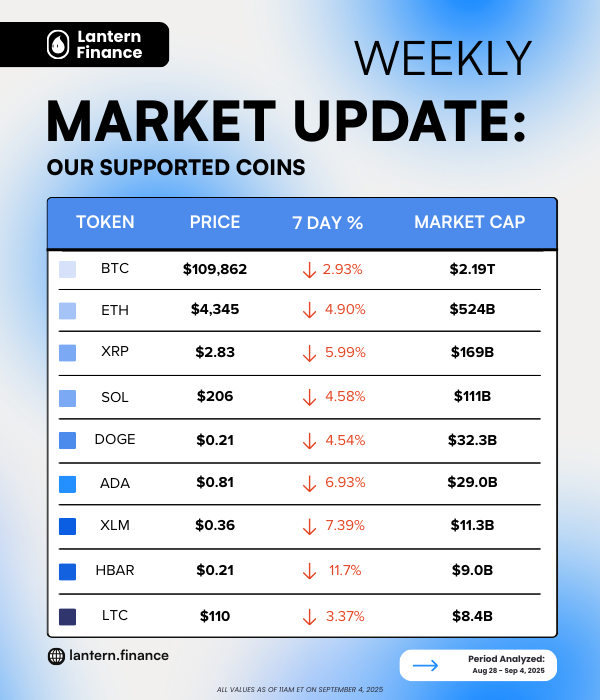
But first, market update!
Two ways to make money in crypto lending
Option A: The Interest Model: Make money from borrowers who successfully pay back their loans over time. Revenue comes from interest payments. Borrower success = platform success.
Option B: The Liquidation Model: Make money when borrowers can't pay back their loans. Revenue comes from liquidation fees and selling borrower collateral. Borrower failure = platform success.
Most platforms use Option B. They just don't advertise it.

How to spot a liquidation-dependent platform
Look at their LTV offer alongside their liquidation fee:
Typical Platform: 75% LTV + 2% liquidation fee
Your Bitcoin drops 16.7% → liquidation triggered
Platform keeps 2% of your collateral as fee
Platform buys your Bitcoin at distressed price
Profits off your loss
So if you borrowed $75,000 against $100,000 of Bitcoin:
They collect $2,000 in liquidation fees
They acquire your Bitcoin at a discount
Assuming BTC bounces back 5-10%, the total profit per liquidation: ~$7,000-10,000
Compare that to interest income: $75,000 × 15% = $11,250 per year
They make roughly the same from one liquidation as they do from a full year of interest payments.
Why high LTV isn't generosity
When platforms offer 85-90% LTV, they're making a calculated bet: "This borrower will get liquidated within 12 months, and we'll make more from that liquidation than we would from 2-3 years of interest payments."
High LTV ratios are liquidation bait. The platform wins when you lose.

Why we focus on cushions, not maximums
Borrowers who maximize their LTV often underestimate how quickly markets can move against them.
However, with Lantern, at 40% LTV your collateral needs to drop 38.5% to receive a margin call notice (65% LTV) and 46.7% for liquidation risk (75% LTV). And if that does happen, we make $0 from fees.
The math is clear: lower LTV ratios create larger cushions for market volatility.
Our approach prioritizes sustainability over maximum extraction. This ensures you can weather market downturns while maintaining access to capital. Also, we charge zero liquidation fees because we want you to keep your loan active.
Our revenue depends entirely on you paying interest successfully. We prosper when you prosper.
Why this matters now
Crypto lending is getting competitive. Platforms are offering increasingly aggressive LTV ratios to attract borrowers.
But higher LTV doesn't mean a better deal. It often means your crypto is at risk of being sold to their liquidation engine.
Questions about how we structure our loans differently?
Text us: (415) 365-0100 or run your numbers: https://lantern.finance/borrow
The goal isn't to get the most money upfront. Our goal is to help you survive the markets and to play the long game in crypto.
The Lantern Team
This newsletter is for educational purposes only and does not constitute financial advice. Always consult with your financial advisor before making lending decisions.